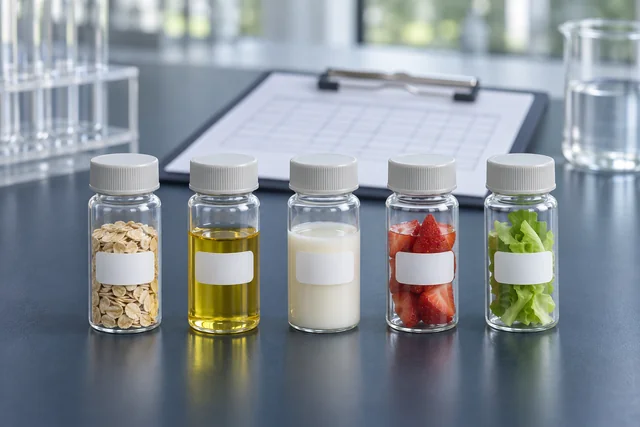
A supplier’s standard laboratory panel can be a useful starting point. A food safety team needs to tie that panel to the product it handles. List the inputs, manufacturing steps, pack, storage conditions and type of customer. Use this record to decide which hazards need preventive controls, supplier evidence or verification tests.
Separate the ingredients and production steps
Begin with the carrier, CBD ingredient and other ingredients. Check which controls are already used by each supplier and what could be introduced during filling, packing or storage. Where relevant, consider residues and contaminants associated with the ingredients as well as allergens or microbiological risks associated with the finished matrix. A change in one component can justify review of a different part of the plan. GOV.UK overview of food safety management systems. FSA guidance on pesticide residues in food.
Give each control an owner
Build a table listing each hazard under review, the control, its owner, the verification record and the action to take if the control fails. For example, a team reviewing an oil with a changed carrier can identify which records cover supplier identity, allergen information and batch-level checks. If a piece of evidence is missing, flag the relevant control and name who will resolve it. FSA MyHACCP prerequisite guidance.
Look for changes across deliveries
Review whether previous issues recur, whether the sampling plan still fits the lot sizes received, and whether the laboratory can test the actual matrix. If a product is shipped with a different pack or supply route, check the aspects of the hazard review that the change affects. Keep revised specifications and supplier evidence linked to a review date so the person making a release decision can use the correct version.
Map the product as it moves through the actual operation
Draw the path from raw ingredient receipt through storage, processing, fill, packing, release and dispatch. Include changeovers, temporary storage, rework if allowed, and cleaning between products. Ask an operator to walk the physical flow against the drawing. A receiving check may be shown in a procedure while material in practice waits in a common area before a status label is applied. Record where the operation can introduce, transfer or fail to remove a hazard. Separate hazards arising from a supplier's process from those introduced after receipt. Cover the food, contact materials and any part of the operation where they interact. GOV.UK food safety management overview FSA MyHACCP prerequisite guidance
Describe the source, consequence and evidence for each hazard
A hazard row should specify the physical, chemical, allergen or microbiological issue, the step and how it could affect the actual item. Evaluate significance using available evidence on the likelihood and impact. An ingredient specification can help trace a chemical concern, while observations of handling help check whether packaging gets damaged on the line. Check allergen risks in ingredients and shared equipment, including declarations and cross-contact where relevant. A certificate may contribute evidence, but the control depends on its linkage to the relevant material, analytical scope and acceptance process. For contaminants covered by specific official requirements, confirm the rules for the actual commodity and intended market. GOV.UK food safety management overview FSA guidance on pesticides in food GOV.UK guidance on food information for consumers
Keep prerequisite programmes and process controls documented
Some issues are managed through established hygiene, maintenance, supplier approval or segregation practices. Others may need a more specific control within the food safety management system. Assign each control a purpose, owner, monitoring method and action if it fails. Where the plan identifies a critical control point, document its criteria and the evidence justifying them. Use meaningful wording for monitoring. For example, identifying the lots a particular check applies to is more useful than recording that a form was completed. A review should determine whether the control can detect a problem while the affected goods are still identifiable and available for action. GOV.UK food safety management overview FSA MyHACCP prerequisite guidance
Follow a new flavour through the map
Consider adding a water-containing flavour preparation to an existing formulation. Start with the new ingredient's composition and supplier evidence, then consider how its addition affects relevant finished-product characteristics, microbial risks, storage assumptions, cleaning and label information. A previously accepted ingredient may be processed differently in its new context. A targeted review can identify which existing evidence still applies, which conditions change, and what checks or validation are required. Hold the revised first lot according to the approval plan while the decision owner checks the changed evidence. Give the original formulation and the changed lot distinct identities in the records so follow-up and any investigation have a clear scope. GOV.UK food safety management overview Food Standards Scotland shelf-life guidance FSA guidance on food traceability
Test whether a problem leads to a documented response
Pick a plausible recorded failure and ask staff to show what happens next. Suppose an intake document is missing a relevant allergen detail. The buyer should know whom to contact, the warehouse should know what to hold, and the decision owner should know which later records rely on that material. Test whether the relevant lot can be isolated and its use in other products traced. Keep the exercise separate from any actual incident. Update the plan where the challenge reveals unclear criteria, missing data or ambiguous authority. Set review triggers around meaningful changes rather than relying only on a scheduled annual check. GOV.UK food safety management overview FSA guidance on food traceability FSA guidance on incidents, product withdrawals and recalls
Review changes in operations as well as ingredients
A new shift, line setup or temporary storage area can change where a check occurs without changing the finished label. Ask staff to show actual practices from the first loading step to material segregation and recording of status. A process review can spot a hold procedure that depends on one experienced person being present. Update training and records so another operator can identify which material is affected when the usual owner is absent.
Verify monitoring during the new arrangement on the first realistic production run and assign an owner to confirm that the revised control works as planned.
Sources
- GOV.UK overview of food safety management systems
- FSA guidance on pesticide residues in food
- FSA MyHACCP prerequisite guidance
- GOV.UK guidance on food information for consumers
- Food Standards Scotland shelf-life guidance
- FSA guidance on food traceability
- FSA guidance on incidents, product withdrawals and recalls